
(What Actually Gets You Cited by ChatGPT, Perplexity, and Google AI Overviews)
TL;DR
AI search is eating into traditional SEO traffic.
- Tools like ChatGPT, Perplexity, Claude and Google AI Overviews now answer questions directly and cite only 2 to 7 sources per response.
- To get cited, your content needs a clear structure, direct answers in the first sentence of every section, real data points, FAQ schema, and consistent updates.
- Reddit is also a surprisingly big deal here. This guide breaks down exactly what to do, in the order that actually matters.
Let me be honest with you from the start: most GEO guides on the internet are written by people who’ve read other GEO guides and summarised them. Nobody’s actually tested this stuff with real clients, real content, real timelines.
I’ve spent 4+ years doing SEO and content marketing for brands across fintech, B2B SaaS, and hospitality. And in the last year, I’ve started watching my clients’ content either get cited in AI answers or get completely ignored by them. The difference between the two is almost never what you’d expect.
This guide is what I’ve actually seen work. I’ll also pull in real perspectives from r/SEO and r/marketing because the most useful insights don’t come from agency blogs, they come from people figuring this out in real time, just like you.
One rule I live by: don’t optimize for AI search before your content is genuinely good. GEO tactics on mediocre content won’t save you. Fix the content first.
First, What Is GEO and Why Should You Care Right Now?
GEO stands for Generative Engine Optimization. It’s the practice of structuring your content so that AI-powered tools like ChatGPT, Google AI Overviews, Perplexity, and Claude actually cite it when generating responses to user queries.
The term was coined by Princeton researchers in 2023. By 2026, it’s become a real discipline with dedicated conferences, agencies, and tools built around it. You’ll also hear it called AEO (Answer Engine Optimization) or LLMO (Large Language Model Optimization).
Here’s why it matters right now: AI referrals to websites grew 357% year-over-year in 2025, reaching over 1.13 billion visits. And 38% of Americans now use tools like ChatGPT or Perplexity as their primary search interface. That’s not a small slice of the audience anymore.
The uncomfortable math: Google shows 10 organic results per page. AI engines cite 2 to 7 sources per response. Getting cited by an AI is significantly more competitive than ranking on page one, and significantly more valuable when it happens.
“Traditional SEO is a ranking race. GEO is a citation race. The problem is most people don’t even know they’re in the second one yet.” r/SEO
GEO vs Traditional SEO: What Actually Changed
A study by Brandlight found that the overlap between top Google results and AI-cited sources dropped from 70% to below 20% in late 2025. AI models are developing their own preferences, and those preferences don’t always follow Google’s signals.
Here’s a quick side-by-side so you can see what’s actually shifted:
| Traditional SEO | GEO / AI Search | |
|---|---|---|
| Goal | Rank in search results | Get cited in AI answers |
| Success metric | Keyword rankings, CTR | Citation frequency, Share of Model |
| Competition | Top 10 results | 2 to 7 citations per response |
| Key signals | Backlinks, on-page SEO | Authority, structure, freshness, stats |
| Best content format | Long-form blog posts | Q&A, structured, direct answers |
5 Things AI Search Engines Actually Look For
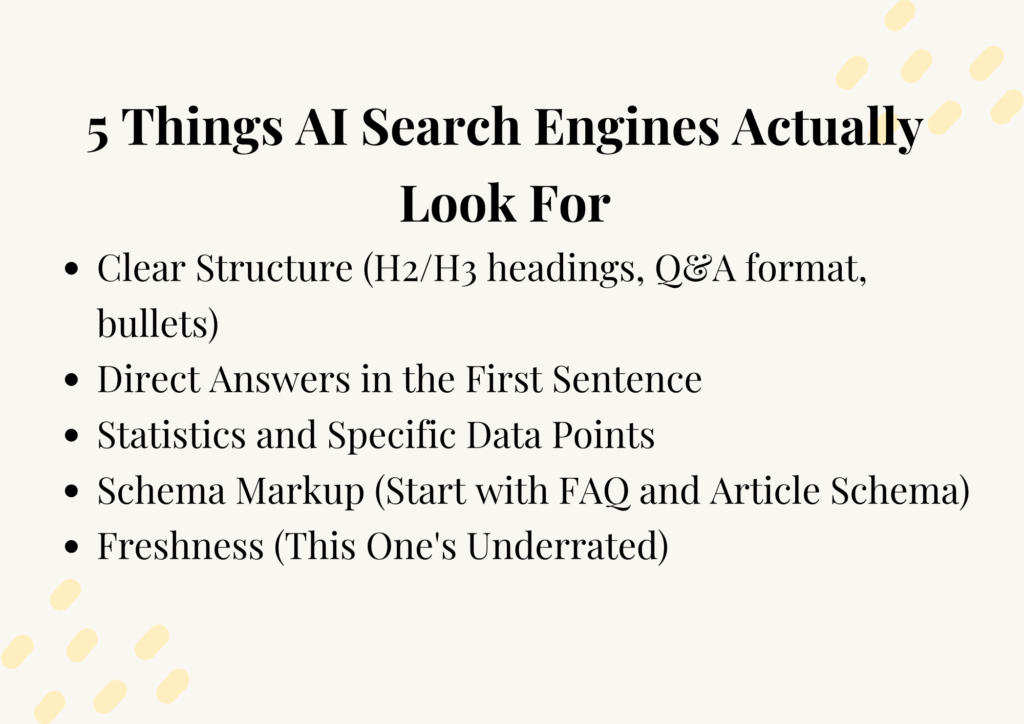
Princeton research showed that targeted GEO strategies improve AI visibility by 30 to 40%. Here’s what consistently moves the needle, based on both the research and what I’ve seen actually work:
1. Clear Structure (H2/H3 headings, Q&A format, bullets)
AI systems don’t read a page top to bottom the way a human does. They break your content into individual passages and evaluate each one for relevance and clarity. Pages with clean heading hierarchies and FAQ-style sections are 40% more likely to be cited by AI engines.
The practical rule: every H2 section should be able to stand alone as an answer. If someone read only that one section, they should still get value from it.
“I restructured a fintech client’s blog into Q&A format. Within 3 weeks, their content started appearing in Perplexity answers for queries they’d never ranked for on Google. The formatting really was the unlock.”r/marketing
2. Direct Answers in the First Sentence
AI models pull individual passages, not full articles. If the answer to a question is buried in paragraph 7 after 400 words of preamble, it won’t get surfaced. Put the answer in the first sentence, then support it with explanation, examples, or data.
Kevin Indig (Growth Memo newsletter, 20k+ subscribers) puts it well: write so that the first sentence of any section could be used as a standalone quote. If it can’t, restructure.
3. Statistics and Specific Data Points
Princeton research shows that adding specific statistics boosts citation performance by more than 5.5% compared to content without data. AI systems use numbers as credibility signals. They make your content more citation-worthy and easier to verify.
Even original data from your own work counts. “We saw a 3x improvement” is more citable than “we saw significant improvement.” Be specific wherever you can.
Honest note: you don’t need to commission a research study. If you’ve run a client campaign and have any numbers at all, include them. Your first-hand data is more valuable than citing someone else’s generic stat.
4. Schema Markup (Start with FAQ and Article Schema)
Proper Article and FAQ schema increases AI citations by up to 28%, according to research from Search Engine Land. Schema communicates to AI systems what your content is, who created it, and how each element connects, in a format machines can read directly.
a. Start with FAQ schema on every article. It makes your questions and answers explicitly available for AI to extract.
b. Article schema helps establish authorship and publish date, which matters for the next factor.
5. Freshness (This One’s Underrated)
Content updated within the last 30 days earns 3.2x more AI citations than older content on the same topic. Metehan Yesilyurt, Co-Founder of AEO Vision, put it plainly: ChatGPT prioritizes recent over perfect. A guide from 2022 loses to mediocre content published yesterday.
What this means practically: add a visible “Last updated” date, refresh your key stats, and update your examples when they get stale. For a new site especially, consistent publishing matters more than occasional big pieces.
Reddit’s Surprising Role in All of This
Here’s something the polished agency GEO guides don’t usually mention: Reddit appears in 68% of AI search responses, according to analysis by Superprompt. It’s the second largest data source cited by ChatGPT, right after Wikipedia.
Why? AI models were trained on datasets heavily weighted toward Reddit. GPT-3’s training mix weighted WebText2 (a corpus built from pages linked on Reddit) at 22% of total training data. That means Reddit visibility is not community marketing. It’s literally part of what the models learned from.
Lily Ray, one of the most cited GEO researchers, has tracked how AI Overview citations pull from authentic user discussions at a significantly higher rate than polished brand content. The authenticity signal is real and measurable.
“I started answering questions in r/fintech and r/SEO with actual data from my client work, not promotional, just helpful. Within 2 months I noticed ChatGPT citing one of my comments in an answer about B2B content strategy. That was my lightbulb moment.” r/SEO
What this means practically: showing up in the right Reddit threads with specific, experience-backed answers is a GEO signal. You’re contributing to the evidence layer that AI engines draw from when forming their answers.
My honest take: don’t go into Reddit to self-promote. Go in to genuinely help. The citation benefits are a side effect of being useful, not a strategy you can shortcut.
ChatGPT vs. Perplexity vs. Google AI Overviews: What to Know?
You don’t need to build entirely separate content strategies for each platform. But knowing their different preferences helps you prioritize where to focus first.
a. ChatGPT (800M+ weekly users):
Prioritizes recent content and authoritative sources. Strong preference for content that directly answers conversational queries. Reddit, LinkedIn, and YouTube are heavily weighted in its citation patterns.
b. Perplexity:
More citation-heavy than ChatGPT. It typically shows sources visibly, which means getting cited here has a direct referral traffic benefit. Structured, factual content with clear headings performs best. Freshness matters a lot.
c. Google AI Overviews:
Most connected to traditional SEO signals. According to Semrush’s 2025 AI Search Report, 99% of URLs appearing in AI Mode also rank in the top 20 organic results. This means your SEO foundation still matters here. Schema and E-E-A-T signals are especially important.
How to Track AI Visibility With Free Tools?
You don’t need an enterprise GEO dashboard to get started. With tools you already have, you can build a solid picture of where you stand.
a. Google Search Console:
Filter your Performance report to see AI Overview impressions. Any query triggering an AI Overview is a GEO opportunity. Check if your site is being cited. Positions 8 to 20 in regular results are your quick-win candidates for optimization.
b. Manual checks (free and underrated):
Once a week, go to ChatGPT and Perplexity and ask the exact questions your content is supposed to answer. Does your site get cited? Does a competitor? This tells you more than most paid tools. Search your brand name too. See how you’re being described.
“Honestly the most useful GEO ‘tool’ I’ve found is just asking the AI the question myself every two weeks and screenshotting the answer. You can see trends over time in what sources it’s pulling.” r/SEO
Your GEO Quick-Start Checklist
Before you publish your next article, run through this:
- Check robots.txt and make sure you’re not blocking AI crawlers (GPTBot, ClaudeBot, PerplexityBot are the main ones to check)
- Add FAQ schema to the article
- Start each H2 section with a direct answer in the first sentence, then expand
- Include at least 2 to 3 statistics with attribution
- Add a visible ‘Last updated’ date
- Include an expert quote or cite a credible external source
- Check if any Reddit threads are ranking for your target keyword. If they are, contribute something genuinely useful there
- After publishing, manually check ChatGPT and Perplexity with your target query
Final Thoughts: GEO Is Not Replacing SEO
GEO is layering on top of SEO, not replacing it. Your SEO foundation still matters, especially for Google AI Overviews. But if you’re only optimizing for traditional rankings, you’re invisible to a growing share of your audience and that share is only going to grow.
The good news: the tactics that earn AI citations are the same things that make content genuinely good. Clear structure, direct answers, original data, consistent updates. You’re not gaming an algorithm. You’re writing for humans in a way that machines can also understand and trust.
My honest take: start with one article. Pick a topic you know well. Apply the checklist above. Then manually verify whether you’re being cited in ChatGPT and Perplexity within 30 days. That feedback loop is the best GEO education you’ll find anywhere.
And if you’re feeling overwhelmed by all of this, that’s normal. This space is changing fast. The businesses winning right now are not the ones who’ve perfected GEO. They’re the ones who started showing up consistently, with genuinely useful content, before everyone else figured out the rules.
Want help building a GEO-ready content strategy for your business? I work with B2B and SaaS brands to create content that ranks on Google and gets cited by AI. Let’s talk: dikshasharmaa.com/contact